AVAILABLE CABOCHONS
(Last updated 1/14/09)
On this page I've illustrated just
a few of the many types of cabochons - numbering close to 1000
- that I have available for wire-wrapping. (Unfortunately most
of these pix were taken in artificial light, which caused visible
reflections, but colors are still reasonably true.)
Many different materials that show
interesting colors and patterns can be found in cabs of standard
sizes and shapes at very reasonable prices, including many different
types of agates and jaspers (see under Quartz in Gems-2).
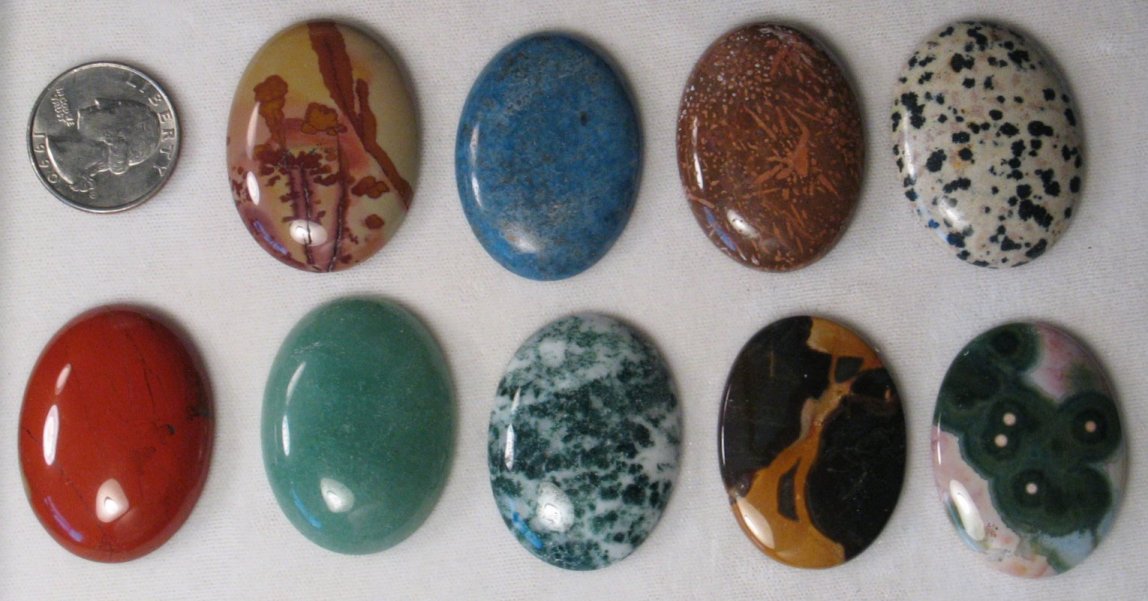
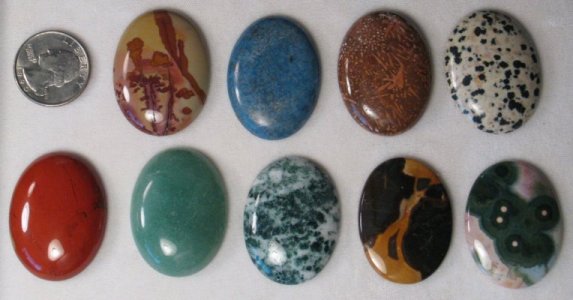
An assortment of such stones is shown below, including flower
jasper (top center left), sodalite (top center; a mineral in its
own right), chrysanthemum stone (top center right; another non-quartz
stone), dalmatian jasper (top right), red jasper (bottom left),
mountain "jade" (bottom center left; actually a jasper),
tree agate (bottom center), and a few less common ones as well,
including Amazon Valley jasper (bottom center right) and ocean
jasper (bottom right). [Note the wide border on the pic below;
just click on the pic to see an enlargement.}
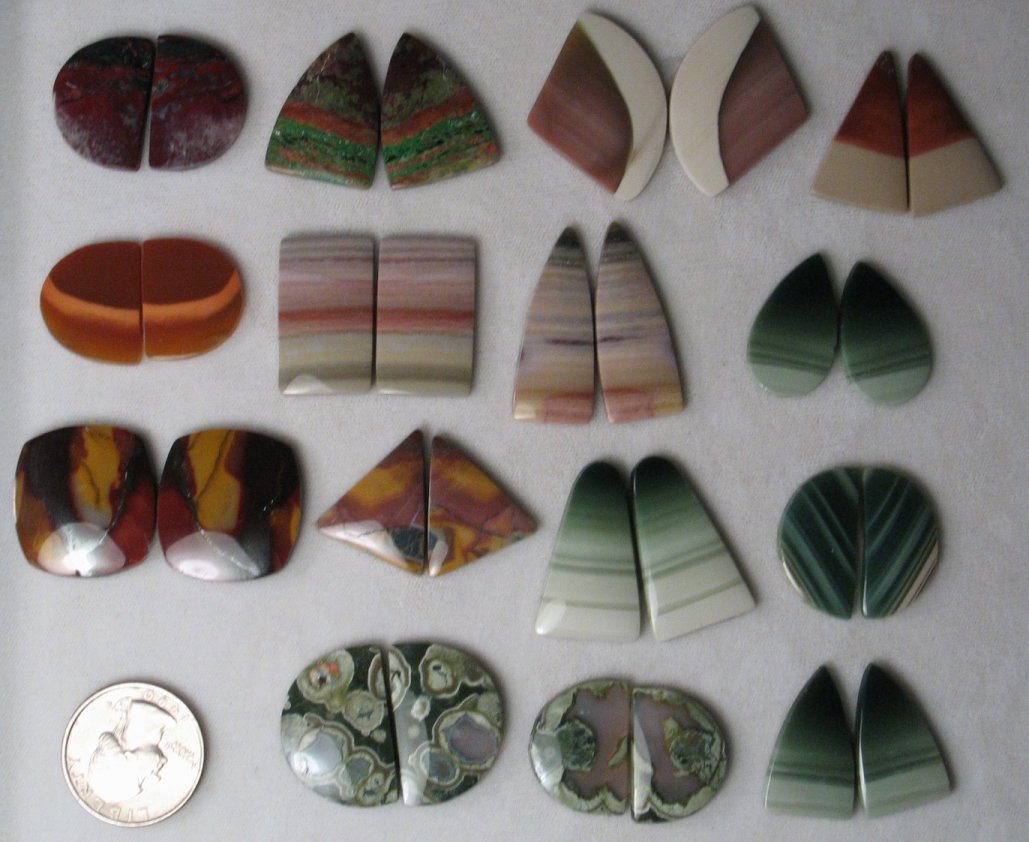
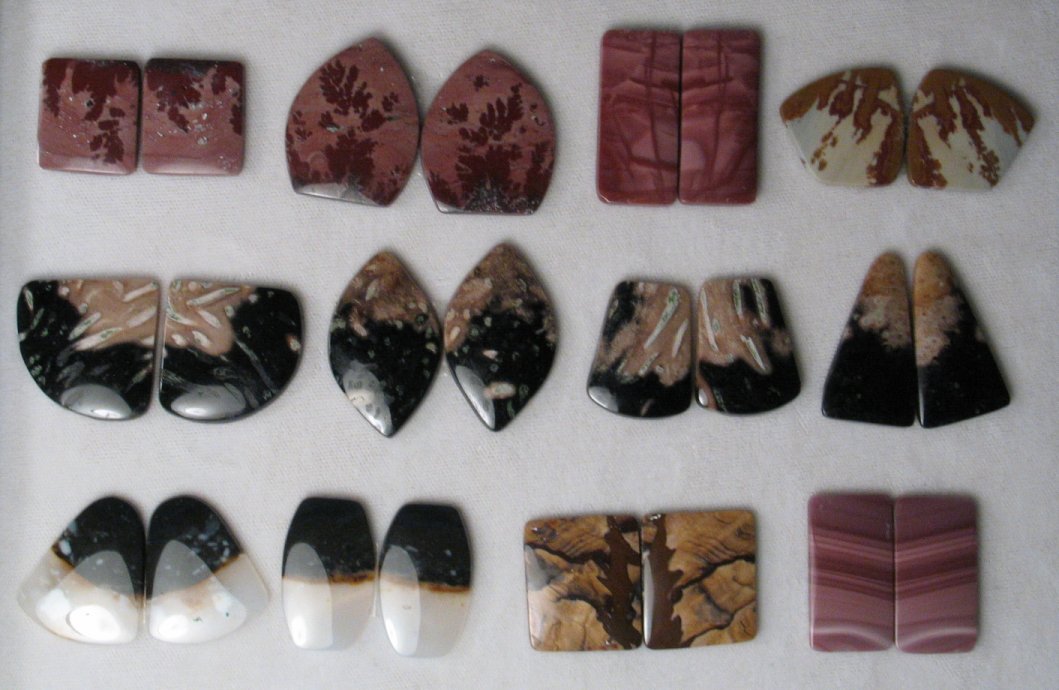
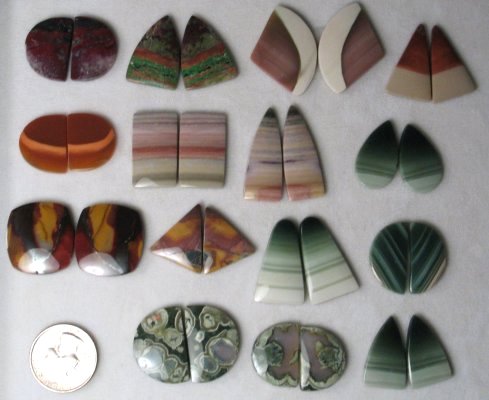
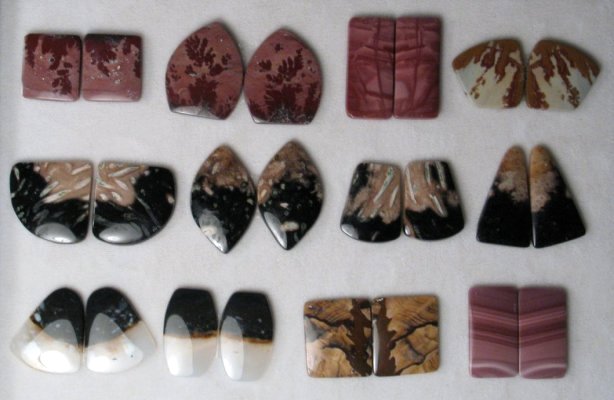
 Sometimes it is cutting that adds
to the value of a material, as in the stones shown in the pix
below. I was fortunate enough to stumble into the booth of master
cutter Raul Rojas of Oro Grande, New Mexico at an open air gem
show in Buena Vista, Colorado and came away with these highly
polished yet incredibly thin (2.5 to 3.5mm) matching (and sometimes
mirror image) cabochon pairs that should make spectacular dangle
earrings. As you can see, Mr. Rojas used many different types
of stones and cut them into many interesting shapes, in addition
to selecting materials with marvelous, eye catching patterns.
Sometimes it is cutting that adds
to the value of a material, as in the stones shown in the pix
below. I was fortunate enough to stumble into the booth of master
cutter Raul Rojas of Oro Grande, New Mexico at an open air gem
show in Buena Vista, Colorado and came away with these highly
polished yet incredibly thin (2.5 to 3.5mm) matching (and sometimes
mirror image) cabochon pairs that should make spectacular dangle
earrings. As you can see, Mr. Rojas used many different types
of stones and cut them into many interesting shapes, in addition
to selecting materials with marvelous, eye catching patterns.
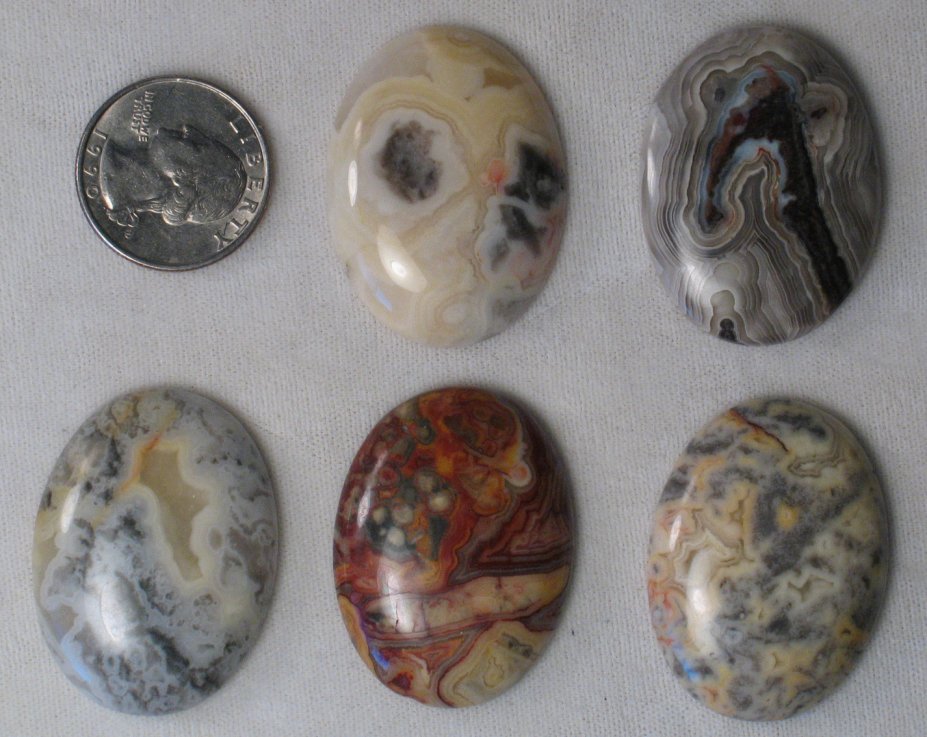
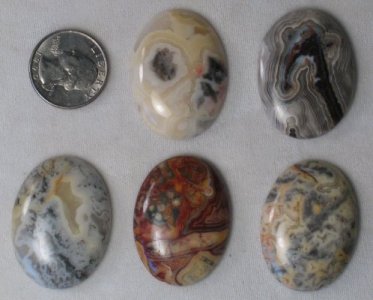
 On the other hand, there are some
jaspers and especially agates that are truly exceptional. One
is Crazy Lace, which derives its name from the fine opaque to
translucent bands that swirl together to create complex and extremely
varied patterns. Much of the material found on the market today
has banding that tends to be various shades of white or gray with
creamy browns, blacks, golds, and occasional pinks or reds, but
material from older collections displays a much wider variety
of bright colors. Crazy lace comes primarily from Chihuahua and
other locations in northern Mexico; the Sierra Santa Lucia mountain
range just west of the village of Benito Juarez is particularly
famous for its production of "Mexican Crazy Lace."
On the other hand, there are some
jaspers and especially agates that are truly exceptional. One
is Crazy Lace, which derives its name from the fine opaque to
translucent bands that swirl together to create complex and extremely
varied patterns. Much of the material found on the market today
has banding that tends to be various shades of white or gray with
creamy browns, blacks, golds, and occasional pinks or reds, but
material from older collections displays a much wider variety
of bright colors. Crazy lace comes primarily from Chihuahua and
other locations in northern Mexico; the Sierra Santa Lucia mountain
range just west of the village of Benito Juarez is particularly
famous for its production of "Mexican Crazy Lace."
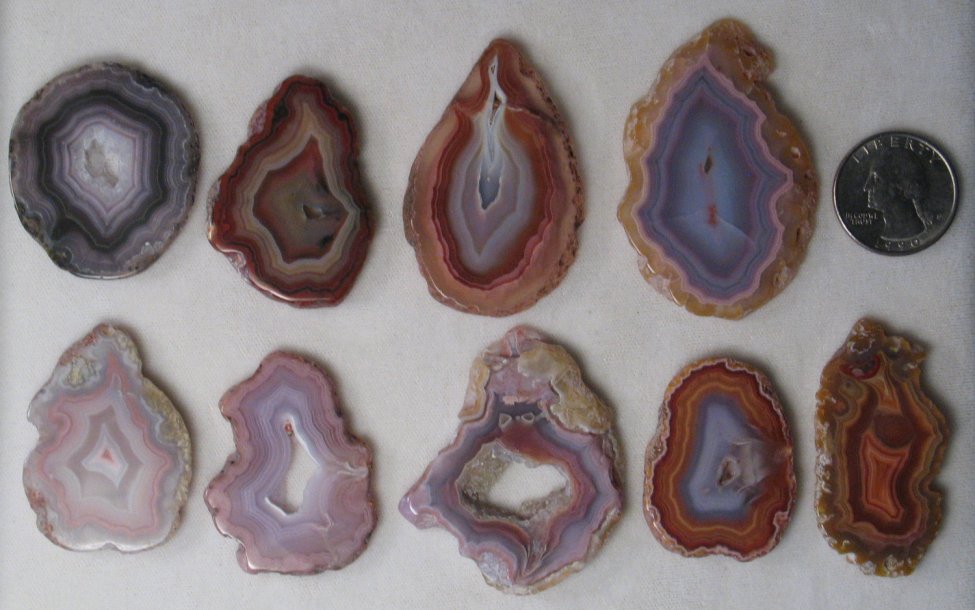
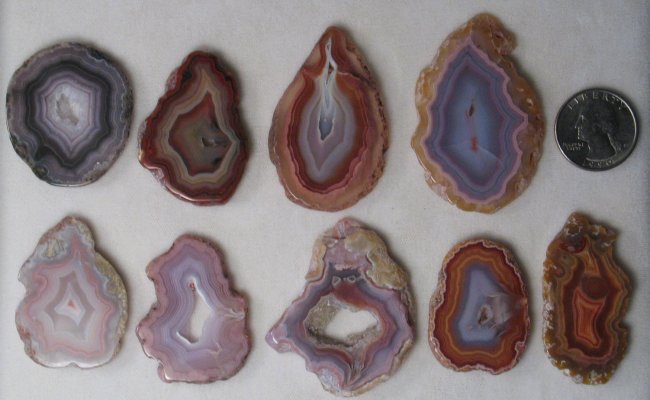
 Another special agate is Laguna,
which comes from an area in Chihuahua, Mexico just east of Estacion
Ojo Laguna (Eye Lake), a tiny train stop about 150 miles almost
due south of El Paso, Texas; it is produced by about a dozen claims
running roughly north to south down a 4 mile stretch of the low
mountains located there. Laguna is a nodular "fortification"
type agate known for its tight banding and bright colors, and
is considered to be the most beautiful banded agate in the world.
The bands may be clear, white, or any other color; and
some specimens show over 100 individual bands per square inch.
Striking (and sometimes jarring) color combinations in the banding,
as well as subtle color shifts, are common. Fine specimens can
be very expensive, but I got these slices, well-polished and with
rounded edges - and with what I think are pleasing colors - at
a very reasonable price.
Another special agate is Laguna,
which comes from an area in Chihuahua, Mexico just east of Estacion
Ojo Laguna (Eye Lake), a tiny train stop about 150 miles almost
due south of El Paso, Texas; it is produced by about a dozen claims
running roughly north to south down a 4 mile stretch of the low
mountains located there. Laguna is a nodular "fortification"
type agate known for its tight banding and bright colors, and
is considered to be the most beautiful banded agate in the world.
The bands may be clear, white, or any other color; and
some specimens show over 100 individual bands per square inch.
Striking (and sometimes jarring) color combinations in the banding,
as well as subtle color shifts, are common. Fine specimens can
be very expensive, but I got these slices, well-polished and with
rounded edges - and with what I think are pleasing colors - at
a very reasonable price.
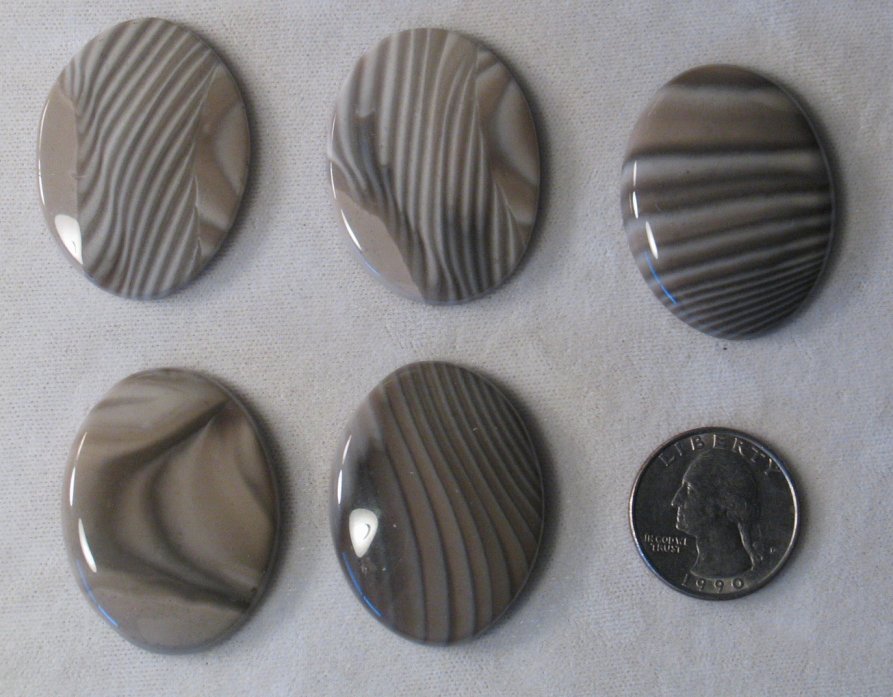
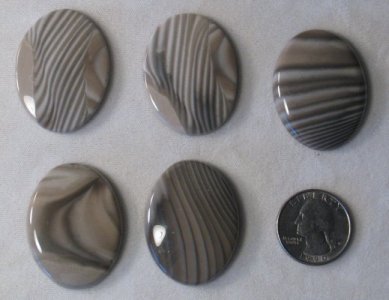
 A "new" stone called Polish
Flint - grey to brownish grey in color and showing alternating
dark and light bands (often translucent) in striking patterns
- has recently become popular for use in jewelry, particularly
in Europe. A true flint - a hard cryptocrystalline form of quartz
categorized as a chert that occurs primarily as nodules in sedimentary
rocks such as limestone, it was used extensively for knapping
throughout prehistory. It comes from an area on the northern fringes
of the Swietokrzyskie (Holy Cross) Mountains in central Poland,
between the towns of Ilza and Ozarów, and many ancient
extraction sites and primitive mines are known, the largest and
most famous of the latter being Krzemionki, used by peoples of
many different cultures from ca 3900 to 1600 BC. The oldest finds
of this flint date to the Middle Paleolithic, but its widest distribution
occurred during the Late Neolithic when the Globular Amphora Culture
exported the material, mainly in the form of flint axes; its use
continued regionally well into the Bronze Age. In modern times
it was regarded mostly as a contaminant during the extraction
and making of lime from the limestone that contained it.
A "new" stone called Polish
Flint - grey to brownish grey in color and showing alternating
dark and light bands (often translucent) in striking patterns
- has recently become popular for use in jewelry, particularly
in Europe. A true flint - a hard cryptocrystalline form of quartz
categorized as a chert that occurs primarily as nodules in sedimentary
rocks such as limestone, it was used extensively for knapping
throughout prehistory. It comes from an area on the northern fringes
of the Swietokrzyskie (Holy Cross) Mountains in central Poland,
between the towns of Ilza and Ozarów, and many ancient
extraction sites and primitive mines are known, the largest and
most famous of the latter being Krzemionki, used by peoples of
many different cultures from ca 3900 to 1600 BC. The oldest finds
of this flint date to the Middle Paleolithic, but its widest distribution
occurred during the Late Neolithic when the Globular Amphora Culture
exported the material, mainly in the form of flint axes; its use
continued regionally well into the Bronze Age. In modern times
it was regarded mostly as a contaminant during the extraction
and making of lime from the limestone that contained it.
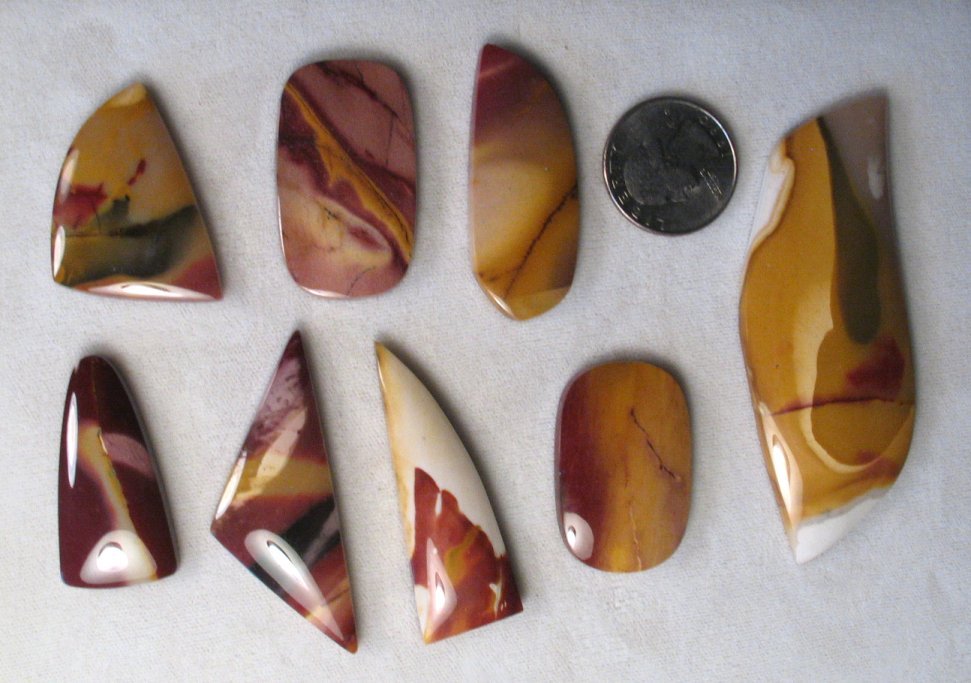
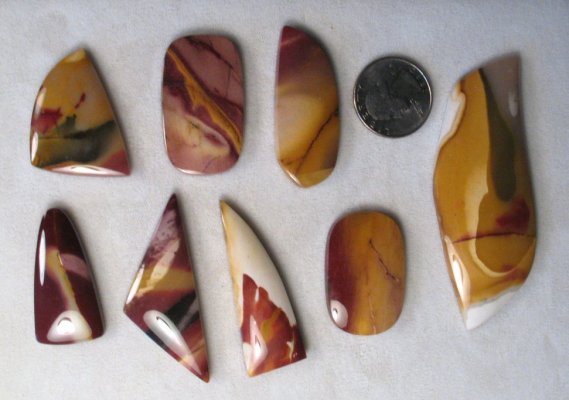
 Among my favorite cabochons are
those produced from fossilized materials. The stones pictured
below are a type of fossiliferous silicified sedimentary rock
called mookaite, named after the principal locality where the
rock is dug, an outcrop along Mooka Creek on a sheep farm (Mooka
Station, covering ca 700,000 acres) located on the west side of
the Kennedy Range about 100 miles inland from the coastal town
of Carnarvon and 600 miles north of Perth, the capital of Western
Australia. According to locals, the Aboriginal word "mooka"
means "running waters," but the rock consists principally
of the remains of tiny marine organisms known as radiolaria,
countless numbers of which were deposited as sediment near the
shore of an ancient sea. These organisms possessed an unusual
skeletal structure of opaline silica; so when the sea retreated
the sediments were cemented into solid rock by silica originating
from the radiolaria themselves (and/or possibly from weathered
rocks nearby). The best material has properties similar to chalcedony,
and generally occurs as nodules lying in decomposed radiolarian
clay beneath the bed of the creek.
Among my favorite cabochons are
those produced from fossilized materials. The stones pictured
below are a type of fossiliferous silicified sedimentary rock
called mookaite, named after the principal locality where the
rock is dug, an outcrop along Mooka Creek on a sheep farm (Mooka
Station, covering ca 700,000 acres) located on the west side of
the Kennedy Range about 100 miles inland from the coastal town
of Carnarvon and 600 miles north of Perth, the capital of Western
Australia. According to locals, the Aboriginal word "mooka"
means "running waters," but the rock consists principally
of the remains of tiny marine organisms known as radiolaria,
countless numbers of which were deposited as sediment near the
shore of an ancient sea. These organisms possessed an unusual
skeletal structure of opaline silica; so when the sea retreated
the sediments were cemented into solid rock by silica originating
from the radiolaria themselves (and/or possibly from weathered
rocks nearby). The best material has properties similar to chalcedony,
and generally occurs as nodules lying in decomposed radiolarian
clay beneath the bed of the creek.
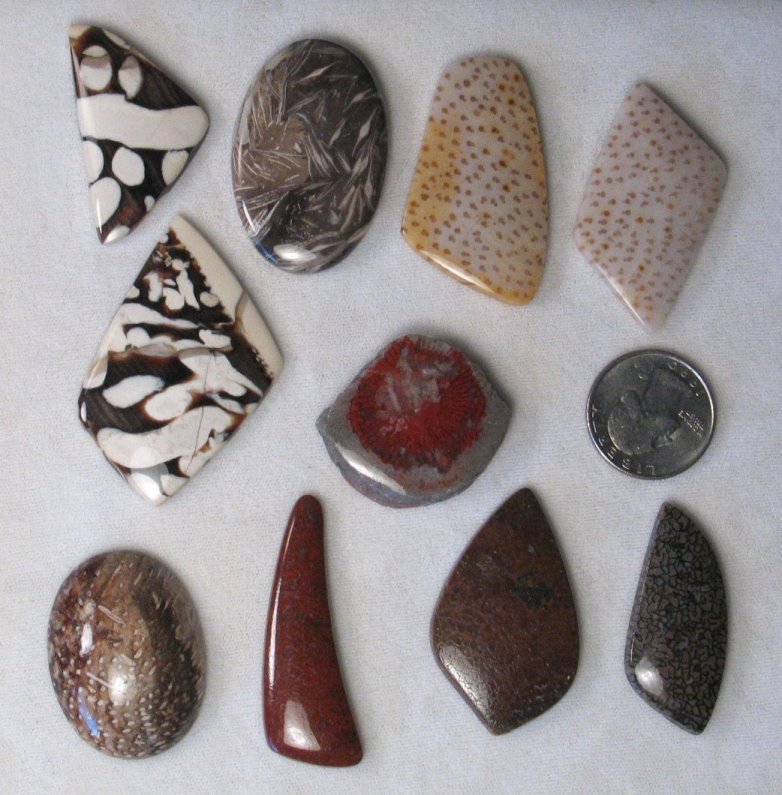
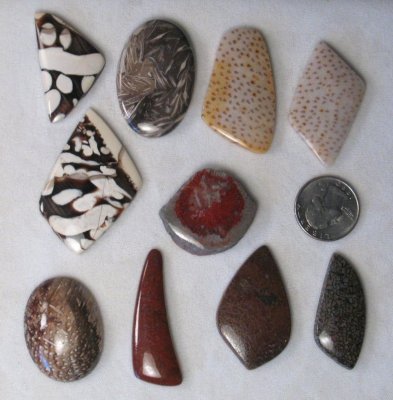
Other fossiliferous silicified materials
can be formed from various plant or animal remains in a way that
leaves their original structures intact. An example familiar to
most people is petrified wood, but many other materials can undergo
this process, as in the petrified algae colonies - called stromatolites
- shown in the pic on the left. The materials in the pic on the
right are all "gemfossils" as well. The black and white
cabs at top left are called "peanut wood," found along
the edge of the Kennedy Range in the "Windalia Radiolarite"
(the same geological formation that contains mookaite). Before
the wood - the main one being "Araucaria,"a podocarp
conifer that grew ca 70 million years ago - was petrified, it
was washed into the ocean as driftwood, then attacked by shipworms
(actually the marine bivalve Teredo) that eventually riddled the
entire piece with boreholes. When the wood became waterlogged,
it sank to the bottom of the ocean, settled into the mud, and
the boreholes filled with a light colored radiolarian sediment
before petrification began. The cab at top center left is called
feather agate, a petrified grass from the island of Sumatra (but
from a different part of the island than fossil coral); inclusions
resembling wheat stalks/seeds (or 'pea grass') are often visible.
The cab at bottom left is another type of petrified grass. The
two cabs at top right are petrified palm wood from the Oligocene
period (ca 38 to 23 million ago); it contains rod-like structures
within its regular grain - these can show up as dots, tapering
rods, or continuous lines, depending on the angle of the cut.
The best palm wood is found in Louisiana - it's their state fossil.
The cab in the center of the pic is a fossilized horn coral from
high in the mountains of Utah; this coral - in which the original
structure has been replaced by red agate - dates from the Silurian
Age (390 million years ago), and belongs to the extinct order
of corals called Rugosa. The three cabs at bottom right, also
from Utah, are cut from fossilized dinosaur bone; the cell structures
are clearly visible.
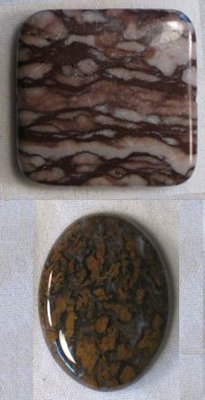
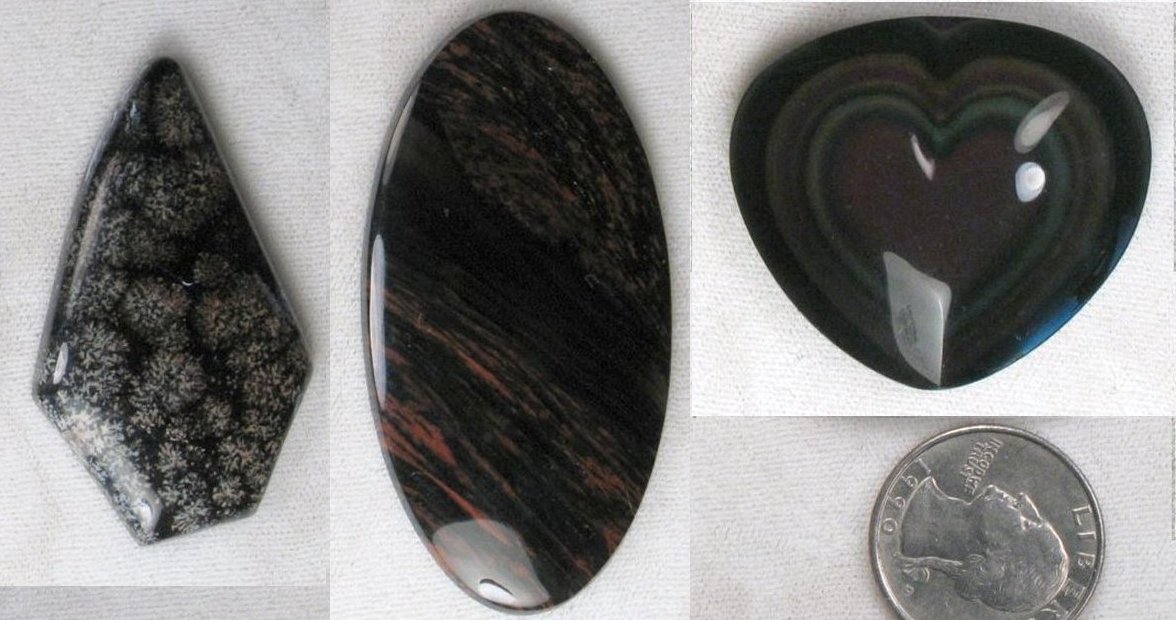
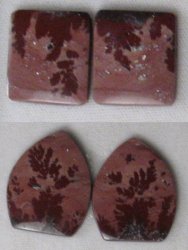
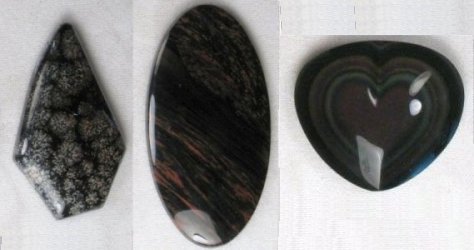
 In addition to various types of
purely silica (ie, quartz) materials, interesting and beautiful
cabochons can be cut from many other types of rock that have a
high silica content. For example, rhyolite is an igneous (ie,
volcanic) rock that typically contains over seventy percent silica;
one of the most attractive is Apache Sage from New Mexico (left;
also called Mimbres Valley Picture Stone). And if rhyolite lava
is cooled too quickly to crystallize, it instead forms obsidian;
one of the most common is snowflake (left; the white inclusions
are radially clustered crystals of cristobalite; the best examples,
as in this piece, are also called flower), but many other examples
are known, including mahogany (center) and rainbow (right; oriented
by a master cutter so its color bands follow the shape of a heart)
In addition to various types of
purely silica (ie, quartz) materials, interesting and beautiful
cabochons can be cut from many other types of rock that have a
high silica content. For example, rhyolite is an igneous (ie,
volcanic) rock that typically contains over seventy percent silica;
one of the most attractive is Apache Sage from New Mexico (left;
also called Mimbres Valley Picture Stone). And if rhyolite lava
is cooled too quickly to crystallize, it instead forms obsidian;
one of the most common is snowflake (left; the white inclusions
are radially clustered crystals of cristobalite; the best examples,
as in this piece, are also called flower), but many other examples
are known, including mahogany (center) and rainbow (right; oriented
by a master cutter so its color bands follow the shape of a heart)
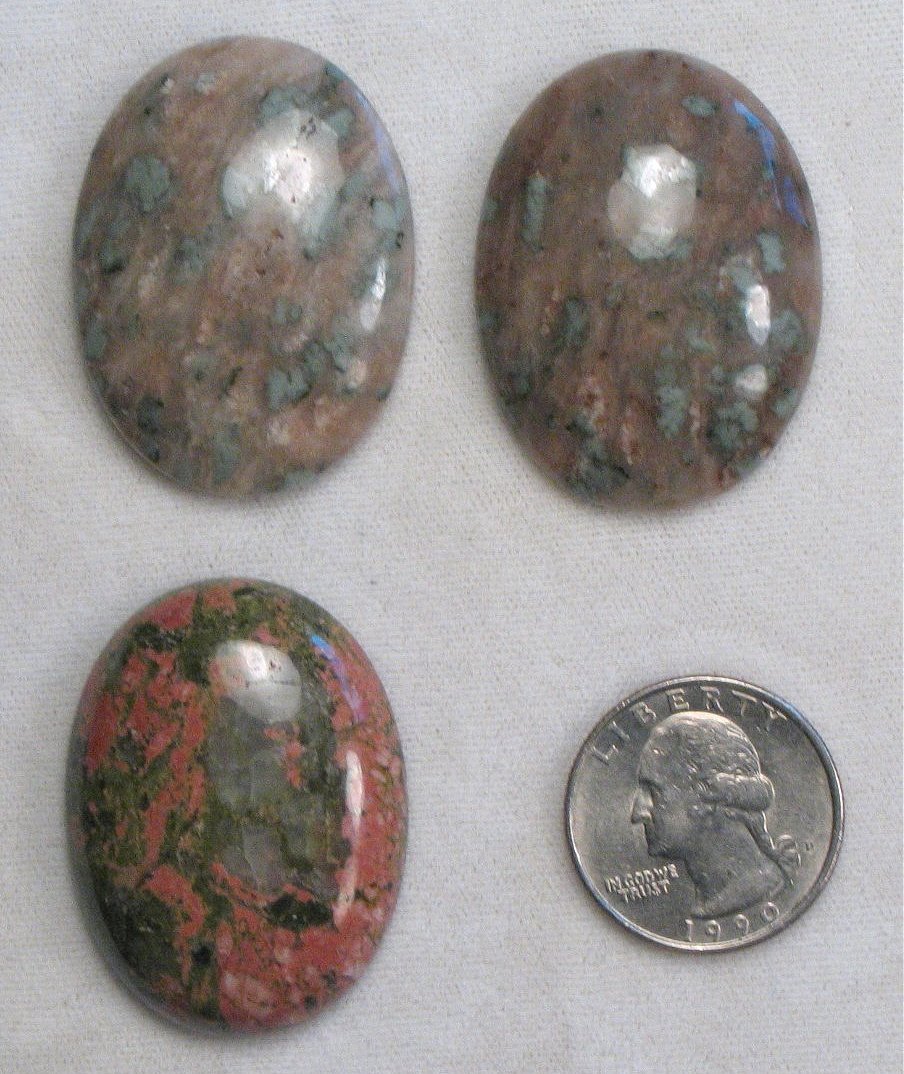
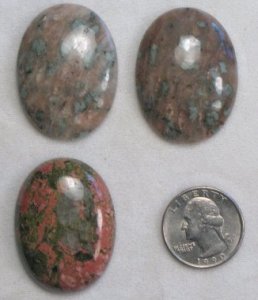
 Nundoorite (top), from an area near
Nundle, Australia, is also mostly quartz, but contains the minerals
andalusite and epidote (the green spots) as well. A stone with
a similar composition is unakite (bottom; named after the Unakas
mountains of North Carolina, where it was first found), another
of my favorites; an altered granite, it is mostly quartz, but
also contains pink orthoclase feldspar and green epidote.
Nundoorite (top), from an area near
Nundle, Australia, is also mostly quartz, but contains the minerals
andalusite and epidote (the green spots) as well. A stone with
a similar composition is unakite (bottom; named after the Unakas
mountains of North Carolina, where it was first found), another
of my favorites; an altered granite, it is mostly quartz, but
also contains pink orthoclase feldspar and green epidote.
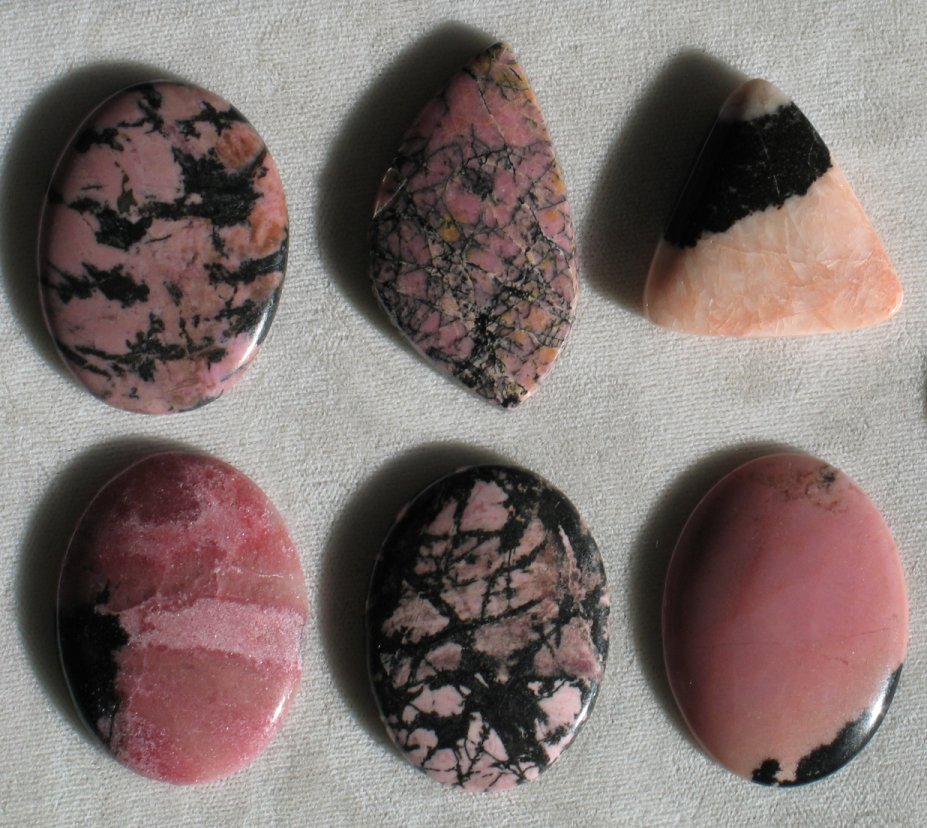
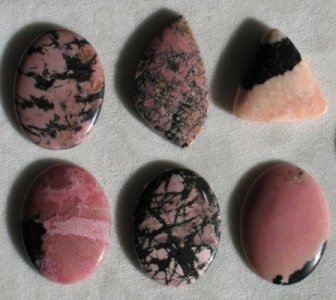
 Another attractive material is the
mineral rhodonite. Pink to red colored, its name is derived from
the Greek word for rose, rhodon, which aptly describes its distinctive
rose-pink color; the stone also usually has inclusion patterns
of black manganese dioxide. Although it is found wordwide, most
gem quality material comes from Australia, but also Russia, Vancouver
Island (Canada), and Brazil; it is also common in the US (it's
the state gem of Massachusetts), eg, the top center stone is from
Oregon. Although not as tough as microcrystalline quartz, with
a hardness of 5.5–6.5, rhodonite cabs take a good polish
and are very suitable for jewelry.
Another attractive material is the
mineral rhodonite. Pink to red colored, its name is derived from
the Greek word for rose, rhodon, which aptly describes its distinctive
rose-pink color; the stone also usually has inclusion patterns
of black manganese dioxide. Although it is found wordwide, most
gem quality material comes from Australia, but also Russia, Vancouver
Island (Canada), and Brazil; it is also common in the US (it's
the state gem of Massachusetts), eg, the top center stone is from
Oregon. Although not as tough as microcrystalline quartz, with
a hardness of 5.5–6.5, rhodonite cabs take a good polish
and are very suitable for jewelry.
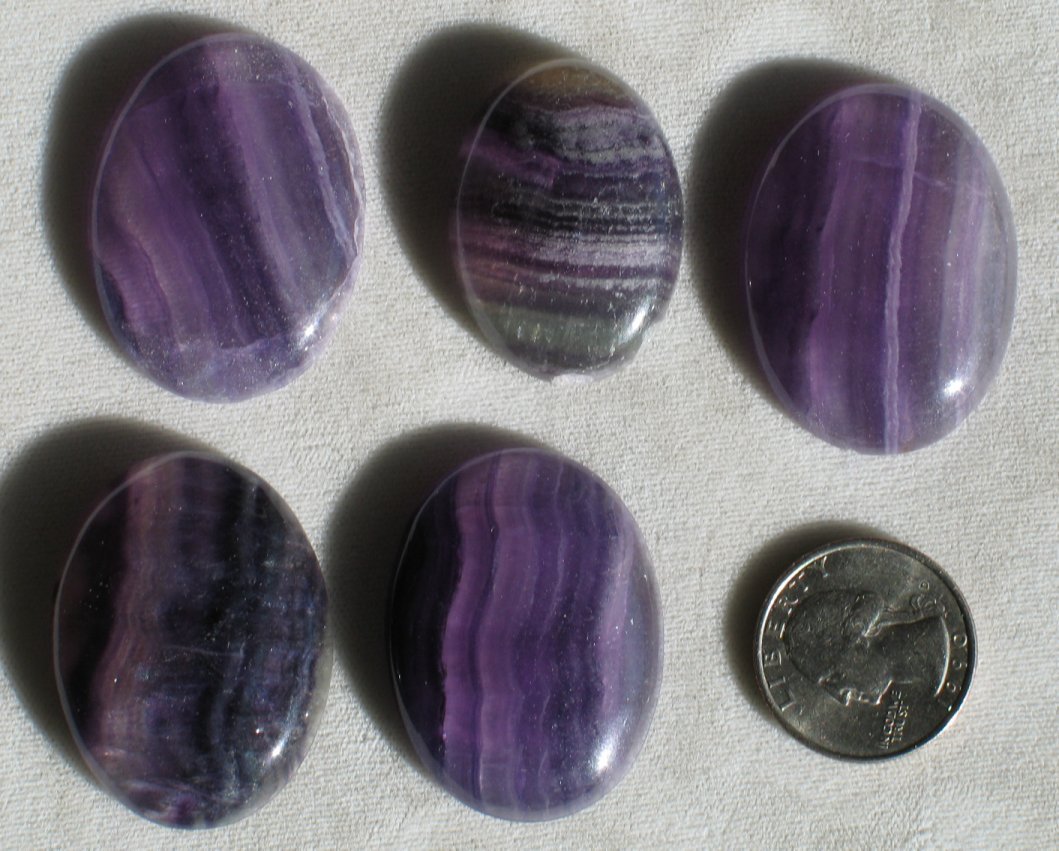
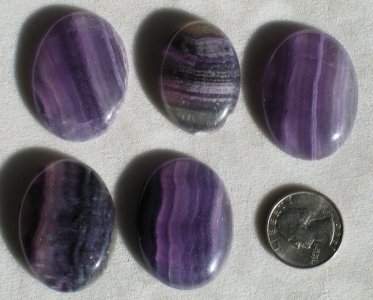
 Fluorite is prized for its glassy
luster and rich variety of colors, but is not commonly used as
a gemstone becaue of its low hardness (4 on the Mohs scale) and
ready cleavage. However, it can be used in jewelry such as pendants
which are not subject to significant wear. A significant percentage
of fluorites have colors arranged in bands or zones, as in the
banded purple fluorites shown below.
Fluorite is prized for its glassy
luster and rich variety of colors, but is not commonly used as
a gemstone becaue of its low hardness (4 on the Mohs scale) and
ready cleavage. However, it can be used in jewelry such as pendants
which are not subject to significant wear. A significant percentage
of fluorites have colors arranged in bands or zones, as in the
banded purple fluorites shown below.
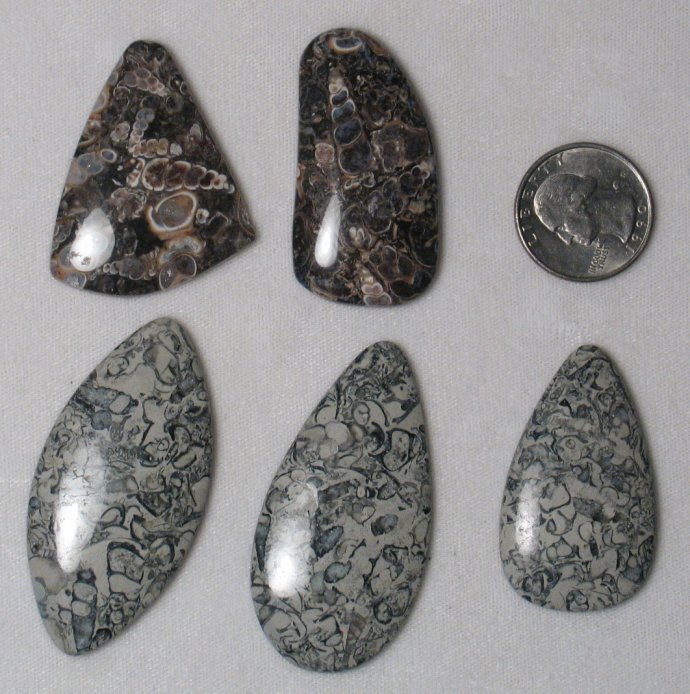
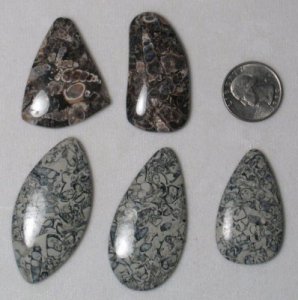
 Turritella (a fossiliferous limestone
found in Texas and California) was named by rock hounds after
the silicified shells it contains - tightly coiled. elongated
spiral cones from sea snails of the genus Turritella (these snails
originated in the Cretaceous period, 145 to 65 million years ago,
and are still widespread in today's oceans). However, most of
the "turritella" now available in the US comes from
an area in the Green River Formation south of Wamsutter in Sweetwater
County, Wyoming; it displays amber gold or blue to gray shell
outlines on a dark brown to grayish black matrix, as in the top
two cabs in the left pic. And recently, paleontologists have determined
that this Wyoming sedimentary rock was deposited at the bottom
of an ancient freshwater lake some time in the Eocene (between
53 and 42 million years ago), and that the fossil shells it contains
are really from the freshwater genus Elimia (still abundant in
shallow lakes and streams throughout North America; the shells
of tiny freshwater shrimp often are visible as well). I'm not
sure where the bottom three cabs in the left pic are from, although
they may have been cut from (true) white Turritella limestone
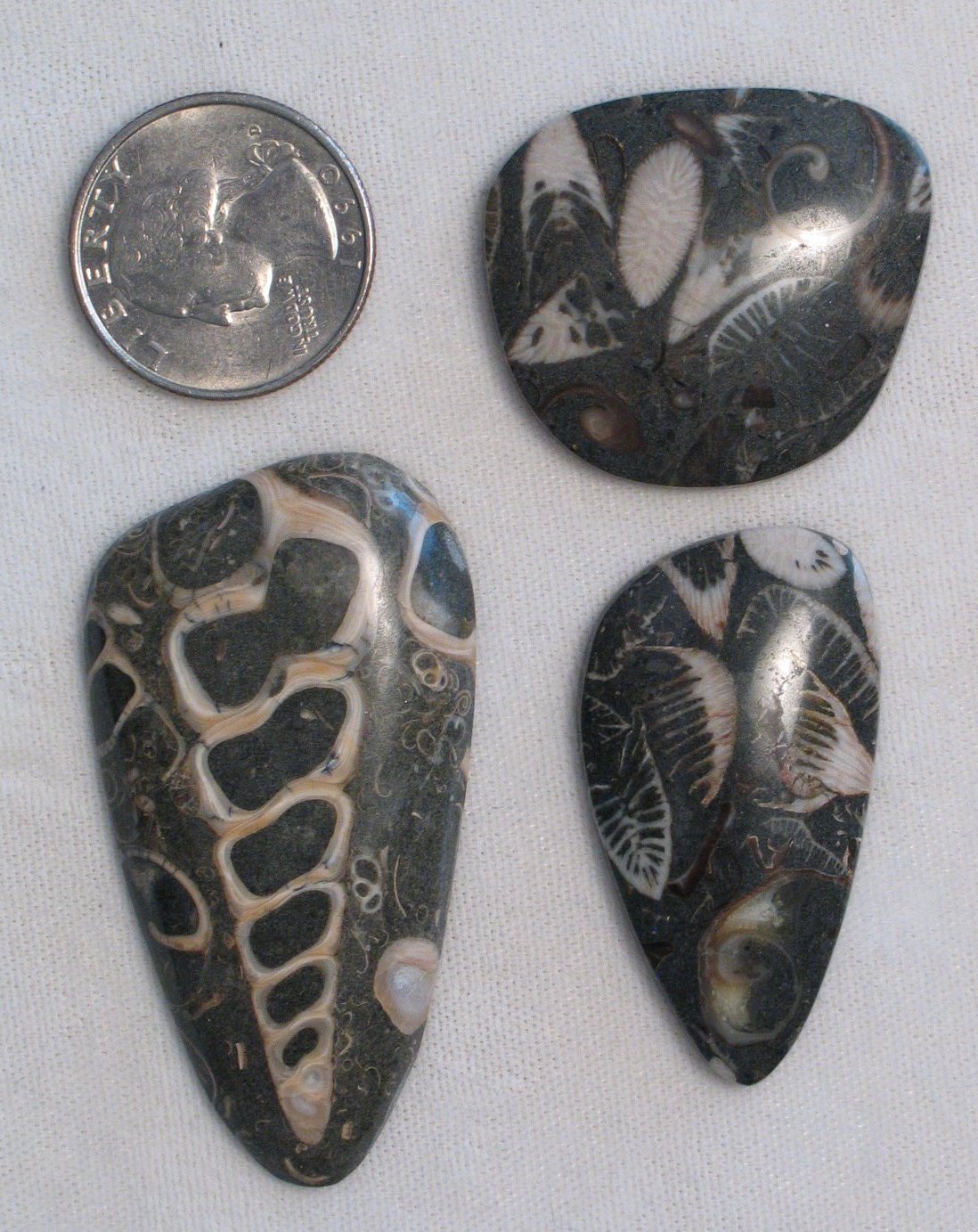
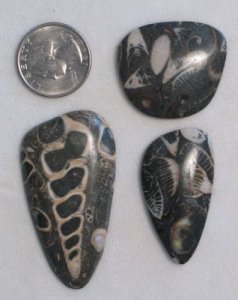
found in the Rocky Cedar area near Elmo, Texas. The cabs in the
right pic are definitely a true turritella (also called crawstone),
found in a remote part of the Baja Peninsula near the town of
El Rosario, Mexico; in addition to turritellids (but from the
Pliocene, ie, ca 18 million years old), the shells of clams and
a horn coral called Flabellum also can be seen. (Among other famous
turritellid stones are one with a white to tan matrix that comes
from an area near Bordeaux, France, and a Miocene sandstone packed
with turritellids from an area called the Erminger Turritellenplatten
near the German city of Ulm.)
Turritella (a fossiliferous limestone
found in Texas and California) was named by rock hounds after
the silicified shells it contains - tightly coiled. elongated
spiral cones from sea snails of the genus Turritella (these snails
originated in the Cretaceous period, 145 to 65 million years ago,
and are still widespread in today's oceans). However, most of
the "turritella" now available in the US comes from
an area in the Green River Formation south of Wamsutter in Sweetwater
County, Wyoming; it displays amber gold or blue to gray shell
outlines on a dark brown to grayish black matrix, as in the top
two cabs in the left pic. And recently, paleontologists have determined
that this Wyoming sedimentary rock was deposited at the bottom
of an ancient freshwater lake some time in the Eocene (between
53 and 42 million years ago), and that the fossil shells it contains
are really from the freshwater genus Elimia (still abundant in
shallow lakes and streams throughout North America; the shells
of tiny freshwater shrimp often are visible as well). I'm not
sure where the bottom three cabs in the left pic are from, although
they may have been cut from (true) white Turritella limestone
found in the Rocky Cedar area near Elmo, Texas. The cabs in the
right pic are definitely a true turritella (also called crawstone),
found in a remote part of the Baja Peninsula near the town of
El Rosario, Mexico; in addition to turritellids (but from the
Pliocene, ie, ca 18 million years old), the shells of clams and
a horn coral called Flabellum also can be seen. (Among other famous
turritellid stones are one with a white to tan matrix that comes
from an area near Bordeaux, France, and a Miocene sandstone packed
with turritellids from an area called the Erminger Turritellenplatten
near the German city of Ulm.)
 Go to Gems-1 | Go to Gems-2
| Go to
Gems-3 | Go
to Wire-wrapped Jewelry | Return to Home Page
Go to Gems-1 | Go to Gems-2
| Go to
Gems-3 | Go
to Wire-wrapped Jewelry | Return to Home Page