Celata Ecotourism and Guided Experiences
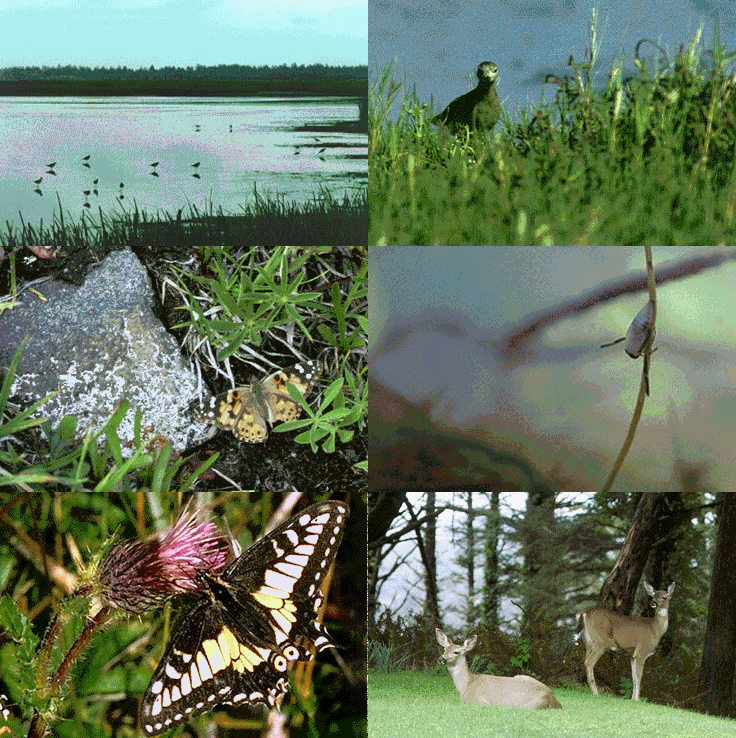 |
I have been studying the wildlife of the
Pacific
Northwest for over 40 years. I
recognize by sight,
song or call most of the birds,
butterflies and
plants likely to be encountered along the
north
coast of Oregon and south coast of
Washington.
I can offer tailored eco-experiences
based on
client interests and needs. If you
are interested
in Oregon Coast bird specialties,
photographing
Coast Range wildflowers or having an
interpretive
guide to regional ecology, write or
e-mail with
your "hit-list" and I can provide an
estimate.
celata@pacifier.com
|
Saddle Mountain Wildflowers
Seabirds from Land
Shorebirds
Five most requested birds
Birds
of
the Columbia Estuary
Saddle Mountain
Wildflowers
Saddle Mountain is the second highest peak in the Oregon Coast
Range.
As such it retains a remnant botany
associated with the Cascade Range, isolated since the last ice
age.
Saddle Mountain has a volcanic past and an
interesting geology. Though not actually a volcano, it is
composed
of lava that flowed from a volcano during
eruptions a million years ago. Trips between May 1 and July
30
can be arranged focusing on close-up
photography of Coast Range Wildflowers.
Seabirds from land
If you're like me, spending a day on a rocking and swaying boat
looking
for pelagic species can be, to say
the least, an uncomfortable experience. Many of these
pelagic
species can be seen from land with the appropriate
equipment and an understanding of timing, tide and weather.
Trips
to seawatching "hotspots" can be arranged
in the fall between August 15 and October 31. See Seabirds
from
land for examples.
Shorebirds
The Columbia River Estuary and Willapa Bay are important migratory
stopovers for shorebirds. Each spring
from late April through May and each fall from July through
September
hundreds of thousands of shorebird
stop to fatten up on estuarine invertebrates. Trips to
Tokeland
and Leadbetter Point NWR in Washington and
the South Jetty of the Columbia River and the Necanicum Estuary in
Oregon provide an opportunity to see
many of the 50 or so species that have been recorded in the
region.
See Shorebirds
on
the North Coast of Oregon
for examples.
The five most requested
birds on
the Oregon Coast
I am regularly asked where to find species that are regional
specialities.
Many of them don't occur within 200
miles of the Oregon Coast (Spruce Grouse, White-headed
Woodpecker),
but of all the birds I am asked about,
these are 5 that can be found (with varying degrees of effort)
within
30 miles of the Oregon Coast centered at
Astoria, Oregon.
Tufted Puffin- a colony of about 150 pair nest on
Haystack
Rock in Cannon Beach, OR from March 5 to
about August 15.
Mountain Quail- This is a tough one, not so much because
it's
uncommon, but because Mt Quail are sneaky.
Any deserted logging road in the Coast Range will eventually
yield
a Mt Quail. They are marginally easier to
find in July and August (when young hatchlings are out) early in
the
morning.
Red-breasted Sapsucker- Another tricky one... a pair
have nested
in the churchyard at Mayger off of
Hwy 30 in Oregon. A pair haunts the memorial orchard at
the Jewell
Meadows Wildlife Area Headquarters.
They are seen yearly Gnat Creek Rd in Brownsmead, OR.
Wrentit- The range for this species stops at the
Columbia River.
Wrentits are not strong enough fliers to cross
the 3.5 mile estuary. The northernmost population can
therefore
be found at the Fort Stevens Historical Area.
They are also easily found at the Fort Steven Park campground
and at
Coffenbury Lake.
Hermit Warbler- Hermit Warblers are very near the
northern edge
of their breeding range in the Coast
Range of Oregon and Washington. They are easily found from
May
through July at Saddle Mountain State
Park and Bradley Wayside in Oregon. During fall migration
flocks
can be found on calm mornings at
Coxcomb Hill in Astoria, late August to early September.
I can guarantee Tufted Puffins, Wrentits and Hermit Warbler when
they're
in season and can usually find Red-breasted
Sapsucker for folks.